Vulnerability Assessment vs Penetration Testing: Which One Does Your Site Need?
Buyers routinely buy the wrong one: a pentest when they needed a baseline scan, or a scan when they needed a human attack chain. What each discipline actually delivers, where each is blind, and the sequence that gets the most security per budget.
📑 Table of contents
Ask ten website owners the difference between a vulnerability assessment and a penetration test and you will get ten confident answers, most of them wrong. The confusion is expensive in both directions: organizations buy a penetration test when what they needed was a baseline scan (and pay consultant rates to be told their footer script library is outdated), or they run a scanner once a year and believe they have been "penetration tested."
The two disciplines solve different problems. Knowing which one you are buying — and which one you actually need right now — is the difference between security budget well spent and security theater.
What a vulnerability assessment actually is
A vulnerability assessment answers the question: what is exposed, and how bad is it? It is a breadth exercise. An automated scanner (with human triage of what the automation finds) works through the entire attack surface — every subdomain, every port, every page, every header, every dependency version — and produces a complete, prioritized inventory of weaknesses.
The properties that define it:
- Breadth-first. Every asset in scope gets checked against every applicable class of issue: known CVEs, missing headers, exposed admin panels, weak TLS, leaked secrets, misconfigurations.
- Continuous. The attack surface changes with every deploy, and the threat landscape changes daily (see how EPSS and the KEV catalog move). Point-in-time is better than nothing, but the value compounds with cadence.
- Evidence-backed. A good modern scanner verifies what it can — proving the vulnerability exists rather than pattern-matching a version string — because the output feeds a remediation queue, and false positives are how remediation queues die.
- Output: a prioritized findings list. Each finding is a door left unlocked, with severity, evidence, and a fix.
What a penetration test actually is
A penetration test answers a different question: can a skilled attacker actually get in, and what happens when they do? It is a depth exercise performed by humans. A pentester does not enumerate every weakness — they pick a target, build an attack chain, and try to reach a goal: exfiltrate a customer record, transfer funds, gain admin.
The properties that define it:
- Goal-oriented. Not "list all issues" but "prove you can reach the payment data" — the deliverable is an attack narrative.
- Human creativity. Chaining a minor information disclosure into an account takeover; abusing business logic that no scanner could recognize as wrong; exploiting the interaction of three individually-low findings.
- Scope-bound and point-in-time. Typically two weeks against a defined scope, producing a report of exploited paths.
- Output: proof of exploitability. What was actually breached, how, and what stopped everything else.
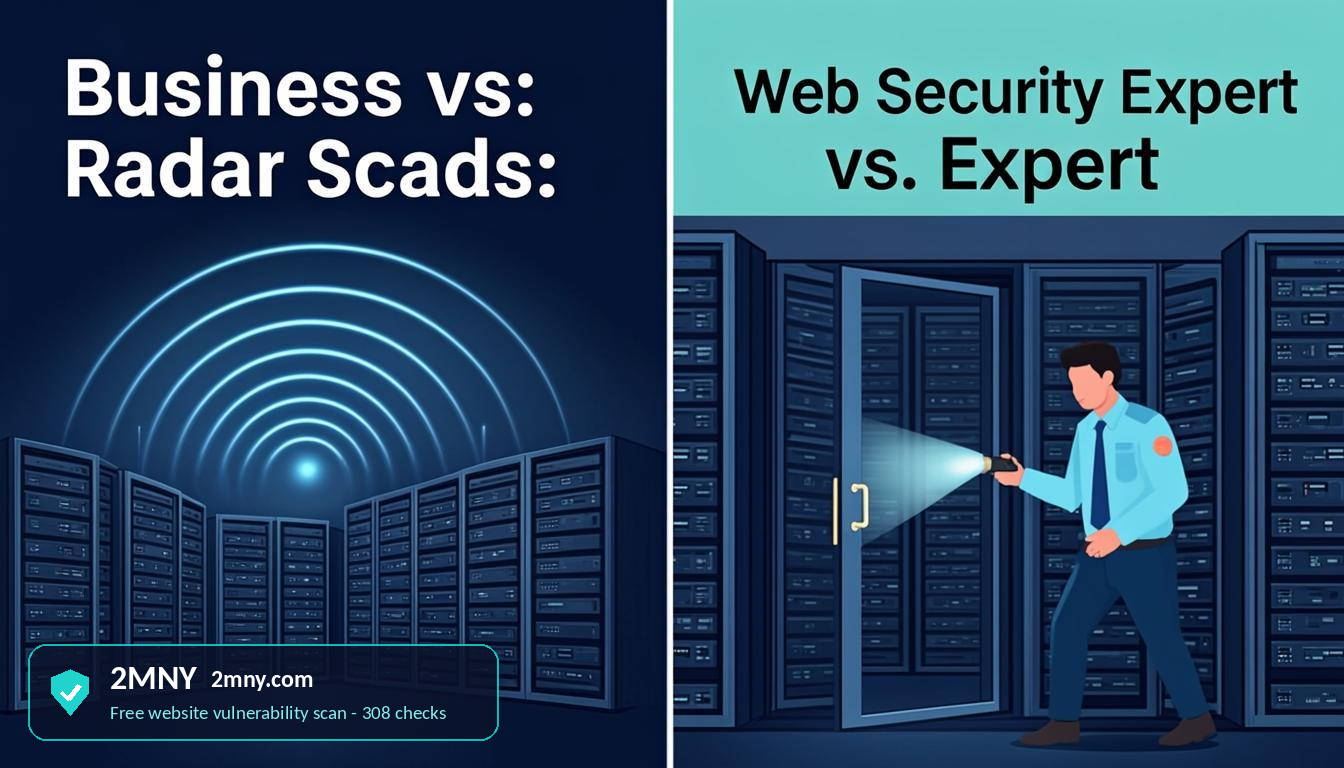
Side by side
| Vulnerability assessment | Penetration test | |
|---|---|---|
| Question | What is weak? | Can it actually be breached? |
| Coverage | Everything in scope | Selected attack paths |
| Executor | Automation + triage | Skilled humans |
| Cadence | Continuous / monthly | Annual or event-driven |
| Finds | Known weaknesses, misconfigs, exposures | Chained attacks, logic flaws, impact |
| Blind to | Business logic, novel chains | Everything outside scope and window |
| Cost profile | Low, recurring | High, project-based |
Neither row makes the other obsolete. The assessment is your routine physical; the pentest is the stress test where a specialist tries to make something break.
What a scanner will never do (and why you should want one anyway)
Honesty about limits is the mark of a serious scanning vendor, so here is the honest list. Automated assessment will not find:
- Business logic abuse — the coupon stack that should not work, the price parameter the client can edit, the trial that never expires when you re-register with a dot in the email.
- Novel chained exploits — three low findings that combine into one critical path. Scanners score findings individually.
- Social engineering, physical, insider threats — out of scope for web scanning entirely.
What scanning does deliver — exhaustively, cheaply, and on every run — is the elimination of the routine: the outdated library, the exposed .git directory, the missing header, the default credential, the forgotten subdomain. And here is the statistic that matters: most real-world breaches do not require creativity. They use known, patchable, scanner-findable weaknesses that had simply been sitting there. Attackers chain exploits because it is cheap; routine exposure is what makes it cheap.
What a pentest misses without fresh scanning
The reverse blind spot is quieter. A penetration test is a snapshot of two weeks. The average application changes constantly — new endpoints, new dependencies, new configuration — and the vulnerability landscape publishes tens of thousands of new CVEs a year. A clean pentest report from eight months ago describes a world that no longer exists.
The pattern that repeatedly precedes breaches: annual pentest passes in March, new dependency with a known exploit ships in July, nobody scans in between, incident in October. The pentest was not wrong; it was stale, and nothing continuous was watching the gap.
The right sequence for a small team
- Baseline assessment now. Scan everything you own. This is the cheapest security action with the highest expected return — free options exist that cover the fundamentals.
- Fix the verified findings. Order by actual risk: exploited-in-the-wild first (KEV), high-probability next (EPSS), then the rest. This is where the breach probability actually drops.
- Put continuous scanning in place. Weekly at minimum for anything internet-facing. Every deploy should be followed by a scan, not a hope.
- Add a pentest when the baseline is clean. Point the humans exclusively at what automation cannot find. You will pay for fewer days and get deeper results — the consultant starts at layer three instead of layer one.
- Feed pentest findings into regression. Every issue the pentest finds should become a standing check, so it never silently returns. This is the compounding loop where assessments and pentests reinforce each other.
What this costs in practice
Consultant-led penetration testing for a web application starts in the low four figures and scales with scope; a proper red-team engagement costs multiples of that. Scanning ranges from free (fundamentals) to low hundreds per month for commercial-grade continuous coverage — and for teams in South Asia, the audit cost guide for Bangladesh breaks down local pricing for both categories.
The economics favor a strong scanning baseline for everyone, and pentests where the asset justifies them: payment flows, healthcare data, anything with regulatory weight, anything that is a repeat target.
Where 2MNY fits
2MNY is a vulnerability assessment platform — 300+ scanner modules covering the exposure classes from TLS to secret leaks, with an evidence-verified philosophy: findings ship with proof, not just pattern matches, because the whole point is a remediation queue you can trust. It does not replace penetration testing, and it will tell you so. What it does is make sure the pentester you eventually hire spends your budget on the problems only a human can find.
Start with a free scan at 2mny.com, read the findings like a pro with the report field guide, and let the cadence — not the calendar — decide when you are ready for the pentest.
Security engineer building 2MNY — 292 free website-security checks — and the open-source Website Vulnerability Scanner. I find exposed secrets, misconfigurations and real vulnerabilities, then explain how to fix them in plain language.
1 Can an automated scanner replace a penetration test?
No, and honest scanner vendors say so. Automation is unmatched at breadth and cadence but cannot reason about business logic — whether a 2% coupon can be multiplied into a free order, or whether that IDOR in a quote workflow leaks the entire customer pipeline. What a good scanner does is make the pentest cheaper and sharper, because the human starts from a verified, prioritized baseline instead of spending days finding low-hanging fruit.
2 How often should I scan vs pentest?
Scan continuously or at least monthly — your attack surface changes with every deploy, and tens of thousands of new CVEs are published every year. A pentest is typically annual for most applications, plus event-driven: before a major launch, after an architecture change, after an acquisition, or after an incident.
3 Is a vulnerability scan enough, or do I need a penetration test?
It depends on your threat model and maturity. Continuous vulnerability scanning is the right baseline for almost everyone: it covers the whole attack surface, runs constantly, and catches the routine exposures that cause most real breaches. A penetration test adds what automation cannot — a human chaining findings into a real attack and proving business impact. Most small and mid-size sites should start with scanning, fix what it finds, and add a pentest for high-value applications or compliance requirements.
4 Which comes first, the assessment or the pentest?
The assessment, virtually always. Pentesting against an unscanned environment wastes expensive consultant hours rediscovering outdated libraries and missing headers — findings automation surfaces in minutes. Scan, fix the verified findings, then commission the pentest so the human effort goes exclusively toward the problems only humans can find.